
In 1970 David Werner wrote “Where there is no doctor: a village health care handbook”. This book has been updated over the years and used extensively by people living and working in rural areas.
The introduction of the book sets out these six principles (Werner, 1993):
1. Health care is not only everyone’s right, but everyone’s responsibility.
2. Informed self-care should be the main goal of any health program or activity.
3. Ordinary people provided with clear, simple information can prevent and treat most common health problems in their own homes—earlier, cheaper, and often better than can doctors.
4. Medical knowledge should not be the guarded secret of a select few, but should be freely shared by everyone.
5. People with little formal education can be trusted as much as those with a lot. And they are just as smart.
6. Basic health care should not be delivered, but encouraged.
There is a growing need for healthcare workers globally, this lack is most acutely felt in rural communities. In the literature these areas are referred to as healthcare deserts (EPHA, 2021; Save the Children, 2011) and they affect all regions of the world. Many of these communities do not have access to a doctor or a nurse.
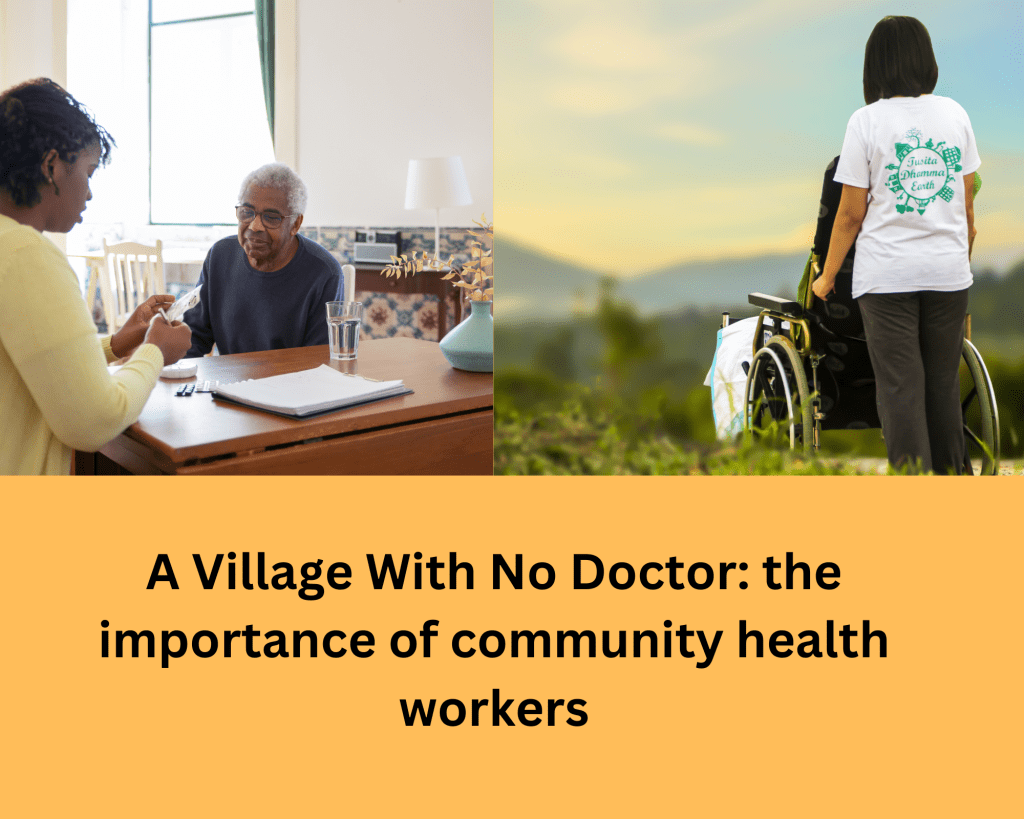
For these communities community health workers provide a vital service and are the only available healthcare professional.
Community health workers are often members of the community they serve (WHO, 2021). The WHO report shows that community health workers working in low and middle income countries focus on interventions within primary care, child health and maternal and child health. In high income countries their work focuses on noncommunicable disease and outreach to underserved groups.
Community health workers perform many different tasks including: diagnostics and treatment, encouraging uptake of health services, health education, data collection and record-keeping, providing psychosocial support, and improving relationships between health systems and the community (WHO, 2021).
Community health workers provide vital healthcare to rural communities. They are seen as a cost-effective approach to delivering primary care services in different contexts (WHO, 2021). More needs to be done to support community health workers in being recognised for the work that they do. There is more work to be done on improving their integration into the healthcare system, training and supervision, appropriate financial remuneration and career development.
References:
Werner D. (1993). Where there is no doctor: a village health care handbook. Available at: https://store.hesperian.org/prod/Where_There_Is_No_Doctor.html
EPHA (2021). Medical deserts – A growing problem across Europe. Available at: https://epha.org/medical-deserts-a-growing-problem-across-europe/#:~:text=It%20describes%20the%20growing%20problem,therapists%2C%20carers%2C%20etc.)
Save the Children (2011). Healthcare deserts: Sever healthcare deprivation among children in developing countries. Available at: https://resourcecentre.savethechildren.net/document/healthcare-deserts-severe-healthcare-deprivation-among-children-developing-countries/
WHO (2021). What do we know about community health workers? A systematic review of existing reviews. Available at: https://www.who.int/publications/i/item/what-do-we-know-about-community-health-workers-a-systematic-review-of-existing-reviews
 The Rural Road to Health